
Introduction: A Mind That Cannot Sleep
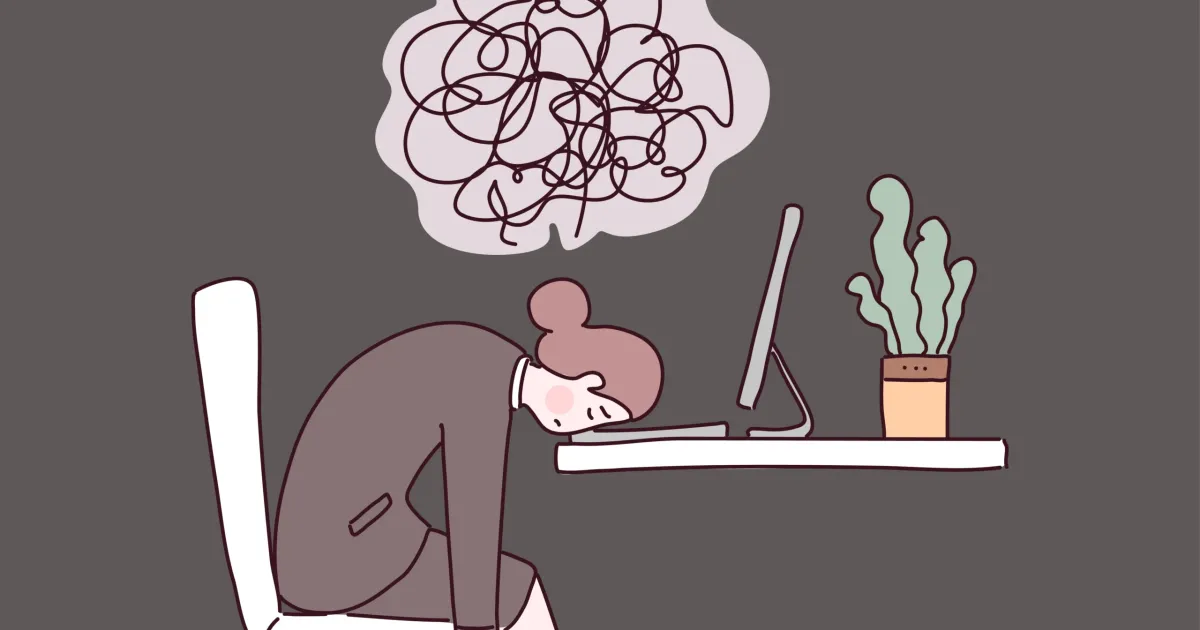
There is a kind of person who is not exhausted by work so much as by thinking about it, and not drained by a decision so much as by everything that comes before it. He lies down on his pillow late at night, believing he is headed for sleep, and his mind opens a file that was never closed and resumes a trial that has not yet begun in any outer court, because it never left his inner one. This is what is known as overthinking, in which the mind turns from a tool into a burden that consumes its owner without moving him a single step forward.
In contemporary psychology this is called "overthinking," and in the scientific literature its counterparts are "rumination" and "repetitive negative thinking" (RNT). Overthinking is not a sign of intelligence, as is sometimes claimed, nor a mark of responsibility, as those afflicted by it imagine. In reality it is a disturbance in the relationship between the mind and its tasks, in which the tool becomes the master and thinking, which exists to serve a person, becomes a burden that consumes him.
First: What Does Overthinking Mean?
Overthinking is not simply thinking a lot. A sensible person naturally thinks a great deal, and there is nothing wrong with that. It is a mental pattern in which the mind stops moving forward and keeps rearranging the same facts, asking the same questions and examining possibilities that have already been examined, without reaching a decision, relief or action. The American Psychological Association (APA) defines it as "obsessive thinking that involves excessive, repetitive thoughts or themes that interfere with other forms of mental activity." The researcher Susan Nolen-Hoeksema, author of the Response Styles Theory, described it as prolonged, repeated negative focus on negative feelings and their causes and consequences, without being accompanied by effective action that eases those feelings. We can say, then, that it is thinking that circles back on itself. It does not head toward a solution but toward more thinking. The person feels he is working mentally, "analyzing the matter" and "being cautious," yet in reality he pays a psychological and physical price with no real progress in his life to show for it. One of its most prominent features is that it is usually not about the task at hand but about the person himself, his standing and his fate: What will people say? What if I make a mistake? What if I miss the opportunity? What if I have been on the wrong path from the start? For this reason the scientific literature describes it as "self-referential thinking" more than thinking centered on the subject matter. Useful thinking ends in a decision or a step. Overthinking usually ends in exhaustion and an inner feeling that the matter is "too big to settle right now," then it is postponed, then resumed later, and the mind returns to the same loop once again.Second: Healthy Thinking Versus Overthinking
It is only fair not to condemn thinking merely because there is a lot of it. Serious living requires reflection, and major decisions are not made lightly. But there is a fundamental difference between thinking that matures a decision and thinking that postpones it indefinitely. Researchers distinguish between adaptive "reflection" and maladaptive "brooding." The former begins with a clear question, moves in a direction, produces an understanding, a step or a position, and then stops. The latter begins with a question, from which another question branches, and from that a third, until the person finds himself far from the original question, lost in a maze he never meant to enter. Healthy thinking is measured by its quality, not its quantity, while overthinking is measured by quantity alone. That is why the overthinker feels he has "thought a lot" and then discovers he has come away with nothing, as if walking on a treadmill inside his head: constant motion, real sweat and zero progress. One of the clearest differences is that healthy thinking calms a person at its end, because it gives him a sense that he has understood or resolved something, whereas overthinking leaves him more tense than before, because it opened files without closing a single one. Studies have shown that pathological rumination is closely linked to longer episodes of major depressive disorder and to increased symptoms of generalized anxiety disorder (GAD).Third: What Happens Inside the Mind During Overthinking?
When a person enters a state of overthinking, it does not happen in a vacuum. Real activity takes place in the mind, with neural, psychological and physical effects that can be observed and described. At the neural level, a network in the brain that researchers call the Default Mode Network (DMN) becomes active. It includes the medial prefrontal cortex (mPFC), the posterior cingulate cortex (PCC) and the angular gyrus, and it is responsible for spontaneous thinking about the self, the past and the future. In moderate thinkers, this network works during rest and then quiets down. In excessive thinkers, however, it works without a truce, and imaging studies (fMRI) show heightened activity and functional coupling with the amygdala, which is responsible for detecting threat. At the cognitive level, balance is lost between the two halves of awareness: focus on negative possibilities swells while attention to positive possibilities shrinks, producing what is called "negative attentional bias." The overthinker becomes like someone viewing the world through a lens that shows only the places of danger and hides the places of opportunity. At the psychological level, a person begins to lose confidence in his own judgment because he never settles on an opinion. Whenever he leans toward a decision, an inner voice comes and casts doubt on it and sends the case back for deliberation. As this is repeated, a feeling takes root in the subconscious that he is "someone who cannot decide," and that very feeling becomes fuel for a new round of overthinking. You can watch Dr. Naser Alfuraih's lecture on anxiety and its psychological impact to explore this topic in greater depth. At the physical level, it does not pass without cost. Constant thinking drains nervous energy and raises internal tension by activating the Hypothalamic-Pituitary-Adrenal Axis (HPA Axis), keeping the body in a chronic stress response. Its symptoms include difficulty sleeping, mood swings, headaches, muscle tension, sometimes shortness of breath, and a general sense of exhaustion out of proportion to the visible effort. In short, overthinking is not merely a mental activity but a state a person goes through with his whole being: mind, heart and body. For that reason it cannot be treated with a kindly piece of advice such as "don't think so much." It calls for deeper understanding and wiser tools.Fourth: Why Do People Fall into Overthinking?
Overthinking is neither an inherited trait nor an inescapable fate. It is the result of converging factors, some related to a person's personality, some to his experience, and some to his environment.Among the main personal causes:
Perfectionism. Someone who wants his decision to be one hundred percent right will keep thinking indefinitely, because life rarely offers certainty at that level. Others include fear of making mistakes, fear of social judgment, and fear of regret (anticipated regret). These three fears turn thinking from a tool of exploration into a tool for fortifying oneself against possibilities.Among the experiential causes:
Difficult past experiences that a person did not manage to close properly, so they remained lodged in his awareness and return as repeated reviews: What if I had acted differently then? Why did I say what I said? How did I allow myself to do that? These reviews feed overthinking in the present, because the person tries, through excessive thinking today, to make up for what happened yesterday. Scientists call this pattern "perseverative cognition."Among the environmental causes:
Information overload. Modern people live in a daily flood of opinions, news and notifications, so the mind is exposed to more input than it can digest, and the surplus turns into restless inner thinking. Likewise, work and relationship environments that give a person no safe space to express himself push him to internalize what he cannot say, so the outer conversation becomes a continuous inner debate.Fifth: The Hidden Face of Overthinking
One thing often escapes the overthinker: his mind deceives him into believing it is working for his benefit when in fact it is draining him. People with this pattern feel they are "careful," or "attentive to detail," or "people of a vigilant conscience," and they may truly be so. But overthinking is not a pure expression of these good traits; it is an exaggerated version of them. This is what the cognitive behavioral school (Cognitive Behavioral Therapy – CBT) calls "positive metacognitive beliefs" about thinking, that is, the belief that excessive thinking is useful and necessary. Healthy caution ends in a step, while excessive caution ends in paralysis. Attention to detail ends in quality, while excessive attention to detail ends in endless postponement (analysis paralysis). A vigilant conscience wakes its owner to make amends, while a conscience burdened by overthinking wakes its owner to punish himself. That is why the first step in freeing a person from this pattern is to admit to himself that what he is living is not a pure virtue but a virtue mixed with a fear he has not named. Once he names it, a conversation with it becomes possible. As long as it wears the cloak of wisdom and caution, it stays safe from review, and the cycle keeps turning.Sixth: How Does a Person Reclaim His Mind?
Escaping overthinking is neither an instant decision nor a magic formula. It is a daily practice that restores the mind's balance little by little. The most helpful approaches can be summarized in several complementary entry points, drawing on: Cognitive behavioral therapy (CBT) and Rumination-Focused CBT (RFCBT), developed by Edward Watkins.To explore this path further, you can read Self-Healing from Anxiety"